
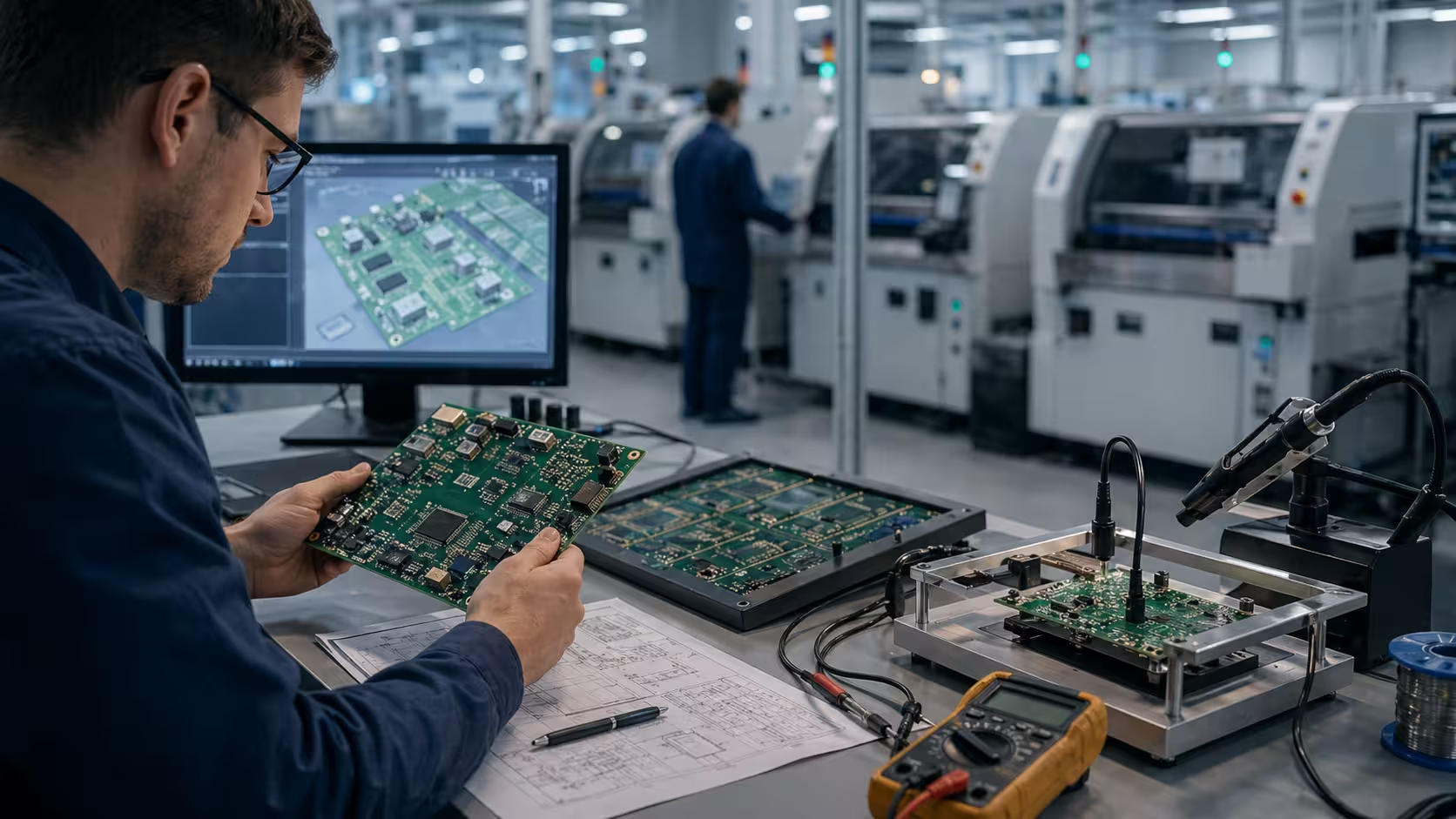
In industrial electronics, validating a design in the lab is only part of the journey. A prototype can do its job, pass the initial tests and prove that the technical idea is viable. That, however, doesn't necessarily mean it's ready to be manufactured in a stable, repeatable and cost-effective way.
The difference shows up when the product enters a real production environment. At that point, decisions that seemed minor during development can turn into recurring issues: components that are hard to source, packages poorly suited to assembly, inefficient panelization, missing test points, processes that are too manual or technical documentation that isn't enough to scale safely.
That's why, in industrial electronics, it pays to distinguish between a functional design and an industrializable one. The first proves that the product can work. The second proves that it can be manufactured under control, with coherent costs, viable supply, traceability and stability from one run to the next.
From functional prototype to industrializable product
The goal of a prototype is to validate a technical solution. Its priority is to confirm that the device meets the functional requirements defined for it: that it measures, communicates, powers, controls or executes whatever it was designed to do. At this stage, it's common to accept certain trade-offs that wouldn't be acceptable in production: manual adjustments, components chosen for immediate availability, loosely systematized testing or layout decisions made with initial validation in mind.
Series production demands another level of maturity. The product has to be assembled repeatably, with available materials, clear processes, controlled documentation and a validation strategy that doesn't depend on one-off interpretations. A board can work perfectly well and, at the same time, be poorly prepared for manufacturing if it requires too much intervention on the line, creates unnecessary cycle times or makes it harder to catch issues early.
This is where DFM, Design for Manufacturing, comes in. It's not about redesigning as a matter of course or questioning a product that already works. It's about analyzing whether the technical decisions made during development allow that product to be manufactured with industrial stability. In many cases, small optimizations to the BOM, the panelization, component orientation or testability can have a direct impact on cost, efficiency and production reliability.
DFM: fix it before the problem scales
Manufacturability problems aren't all of the same kind. Some can be solved at an industrial level, without changing the product's electrical behavior. That's the case with panelization optimization, BOM adjustments, replacing components with compatible equivalents, improving component orientation, basic testability tweaks or certain process improvements. This level reduces friction in production without altering how the device works.
In other cases, the problem calls for an engineering intervention. If the layout makes assembly difficult, if critical test points are missing, if a package complicates manufacturing, if electrical decisions need revisiting or if the released documentation doesn't allow for scaling with guarantees, the optimization has to act on the design itself. This second level of DFM involves deeper changes and requires subsequent technical validation, but it can be decisive in turning a functional design into a product ready for more demanding volumes.
The key is to diagnose the level of the problem correctly. Applying an engineering intervention when an industrial improvement would have been enough can drive up the project's cost unnecessarily. But sticking to surface-level adjustments when the problem lies in the design only postpones the issue. A well-framed DFM analysis makes it possible to separate the operational from the structural and decide which changes deliver a real return in manufacturing.
Real data for better decisions
The most reliable way to assess a product's industrialization is to observe how it behaves when it enters production. Prior estimates are useful, but real data make it possible to pinpoint exactly where the bottlenecks appear: first-pass yield, cycle times, assembly issues, functional-test rejects, adjustments needed on the line, supply problems or points in the process where stability is lost.
At Edison Electronics, this information is gathered in the Post Production Report after the first manufacturing run. This report makes it possible to analyze the run's real performance, identify opportunities for improvement and assess their technical and economic impact. Its purpose isn't only to document what happened, but to turn that first production run into an objective basis for deciding how to optimize the product.
This approach avoids acting on intuition. Optimizing with judgment doesn't mean modifying the design out of excessive caution, but intervening where there is real impact: cutting times, improving testability, simplifying the BOM, stabilizing supply, fixing recurring issues or getting the product ready for a higher volume. In industrial electronics, competitiveness doesn't depend only on the product working; it depends on it being manufacturable, repeatable with stability and viable run after run.
That's why building in industrial judgment from the earliest design phases reduces downstream risks. And when the design already exists, analyzing its manufacturability makes it possible to correct friction before it affects cost, quality or production continuity. A functional product is the starting point. An industrializable product is the one that's truly ready to compete in the market.