
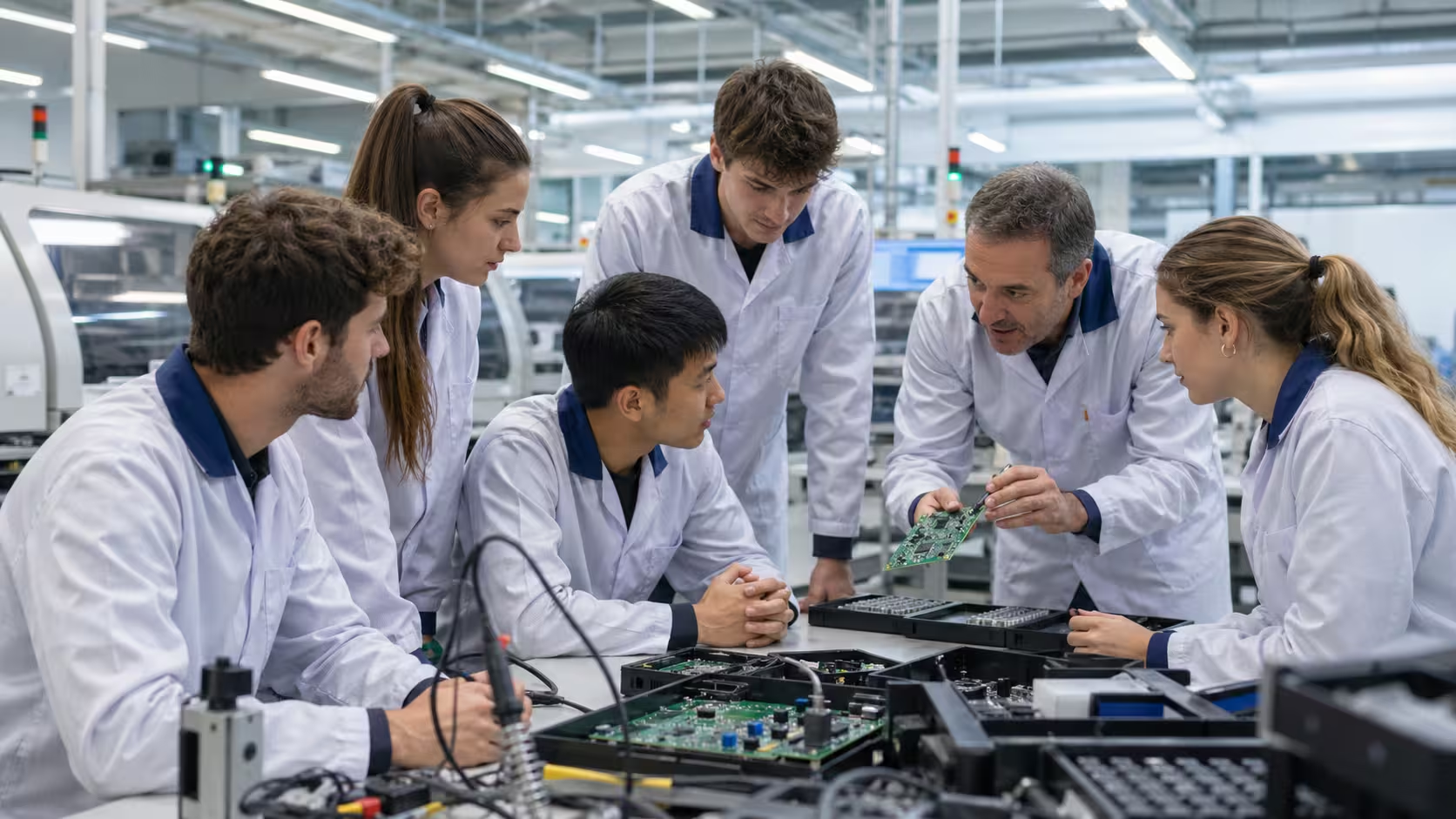
Since 2025, Edison Electronics has been working with educational centers and universities to bring young, international talent into its industrial environment. This initiative is part of a long-term vision: strengthening the connection between technical training, hands-on shop-floor experience and professional development within the electronics sector.
In a company with more than three decades behind it, accumulated knowledge doesn't live solely in processes, machinery or documentation. It also lies in how you read a design, anticipate an incident, organize a production run or make decisions that affect a product's final quality. Bringing in new profiles in this context lets the next generations get closer to an industrial reality that can't always be reproduced in the classroom.
For Edison Electronics, technical training isn't seen as an activity separate from the business, but as a natural part of its evolution. The company has grown by combining experience, industrial investment, in-house engineering and continuous improvement. Integrating young talent into this environment makes it possible to pass on that way of working and, at the same time, bring fresh perspectives to an increasingly demanding industry.
Training tied to industrial reality
Industrial electronics calls for a practical understanding of the product's full life cycle. It's not enough to know electronic design from a theoretical standpoint; you also need to understand what happens when that design moves to manufacturing, how materials are managed, how a unit is validated, what role traceability plays and which decisions determine the stability of a production run.
An industrial environment offers exactly that complete view. It lets you see how engineering, production, quality control, technical documentation and process improvement coexist within a single plant. For people in training, this exposure is especially valuable because it connects academic learning with real problems: products that have to be manufactured repeatably, components that have to be available, processes that have to be efficient and devices that have to perform reliably over time.
This connection also brings value to Edison Electronics. Training talent in direct contact with the reality of the plant helps build profiles that are more aligned with the current needs of the electronics industry. In a sector where precision, traceability and adaptability matter more and more, gradually bringing in new professionals helps strengthen the company's technical continuity.
A commitment aligned with Edison Electronics' evolution
Collaborating with educational centers and universities fits the current stage of Edison Electronics. In recent years, the company has reinforced its engineering department, consolidated its industrial capacity and evolved from a model centered on electronic assembly toward a broader role as an end-to-end technology partner.
That evolution calls for teams able to understand the product from different perspectives: design, industrialization, manufacturing, validation, evolutionary maintenance and continuous improvement. That's why bringing young talent into this environment isn't only about a need to grow; it's about the determination to preserve and broaden the technical judgment that underpins the company's model.
Integrating international profiles also adds a dimension that's consistent with the reality of the sector. Electronics works with global supply chains, shared technical standards and clients operating in diverse markets. Having talent trained in different contexts helps broaden the team's perspective and prepare the organization for an ever wider range of projects.
Committed to an industrial future
The agreements with educational centers and universities reflect a way of understanding growth based on continuity. The experience Edison Electronics has built up over more than thirty years has value insofar as it can be passed on, updated and projected toward new generations of technical professionals.
Training young talent doesn't replace the team's experience. It complements it. It allows the company's operational, industrial and technical knowledge not to remain solely with those who have already built it, but to be integrated into new professionals ready to keep developing it.
In an industry where products have to be increasingly reliable, traceable and adaptable, training talent isn't just a corporate responsibility. It's an investment in technical capability, industrial continuity and a competitive future.